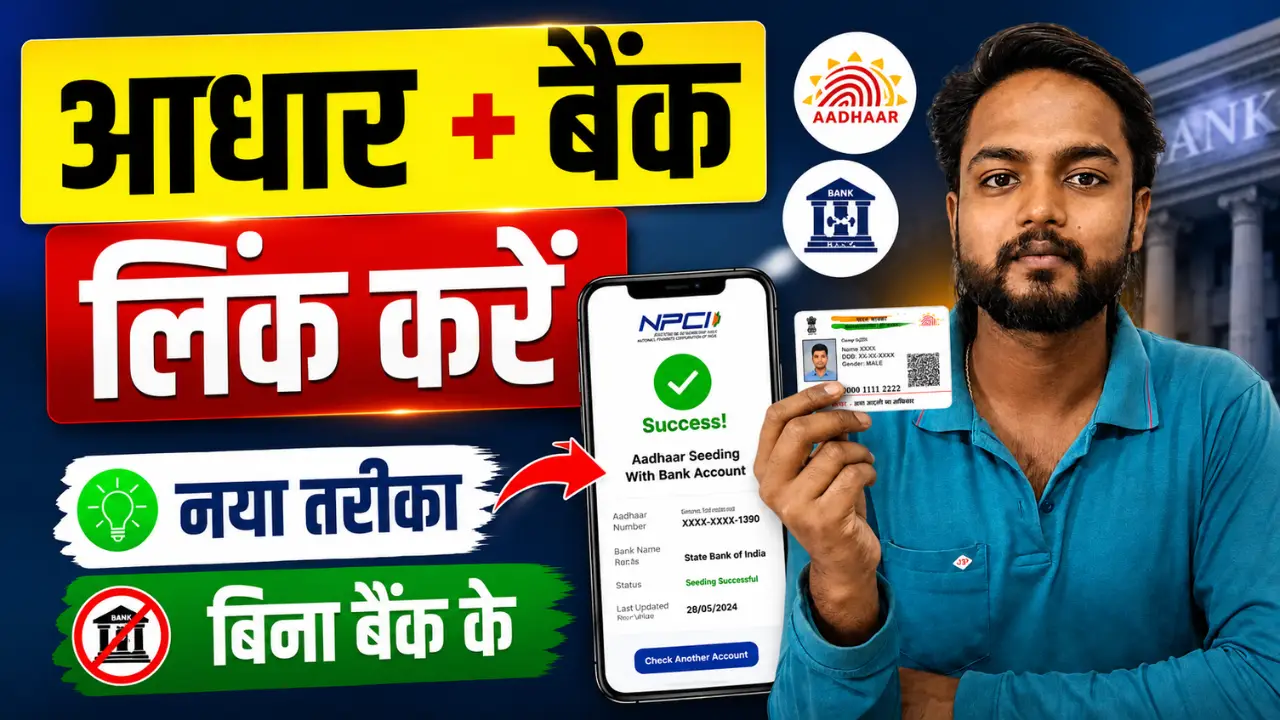
Linking Aadhaar with Bank Account Online:- Linking your Aadhaar card to your bank account is essential, primarily because it is mandatory for directly receiving government subsidies (DBT)—such as those for LPG, scholarships, pensions, and the PM-Kisan Samman Nidhi—into your account. This process prevents fraud, verifies identity, and ensures financial security by guaranteeing that funds reach the intended beneficiary. You can link your Aadhaar to your bank account via the NPCI (National Payments Corporation of India) network.
Complete process of seeding Aadhaar with bank
Step 1:- First, you need to visit the official NPCI portal by clicking on the link provided Above: https://www.npci.org.in/
Step 2:- After visiting the official portal, click on the three lines and go to the ‘Customer’ option.
Step 3:- Next, you will find an option for ‘Bharat Aadhaar Seeding’; click on it. Then, an option for ‘Aadhaar Seeding’ will appear; click on that as well.
Step 4:- A form will then appear where you need to fill in certain essential details, such as your Aadhaar number; select your bank account; tick the ‘Fresh Seeding’ option; enter your bank account number; and finally, submit the form.
Step 5:- And that’s it—your entire process will be complete, and your bank account and Aadhaar card will be linked within 2 to 3 days.
In this way, you too can link—or “seed”—your bank account with your Aadhaar card.
Is It Safe to Link Aadhaar with a Bank Account?
Aadhaar should be shared only through legitimate and trusted channels.
UIDAI states that merely knowing someone’s Aadhaar number does not allow another person to withdraw money from an Aadhaar-linked bank account. UIDAI also says it does not receive or store bank-account details merely because Aadhaar is linked with a bank.
However, you should never share your bank PIN, password, ATM PIN or OTP with anyone. Always use your bank’s official website, mobile application or branch for Aadhaar-related banking services.
What is NPCI Aadhaar seeding?
NPCI Aadhaar seeding is the process through which a bank, based on customer consent, updates the NPCI mapper so Aadhaar-based payment transactions can be routed to the mapped bank.